Our Hair Restoration Services
Surgical hair restoration, medical treatment and long-term follow-up — performed by physicians.
Hair loss has a cause, and the cause determines the treatment. Our services cover the full pathway: diagnostic assessment, surgery where it is indicated, medical treatment to stabilize the condition, and follow-up through regrowth. Here is what each option involves.
Explore our hair restoration services and find the information you need to better understand your options.
Schedule a consultation
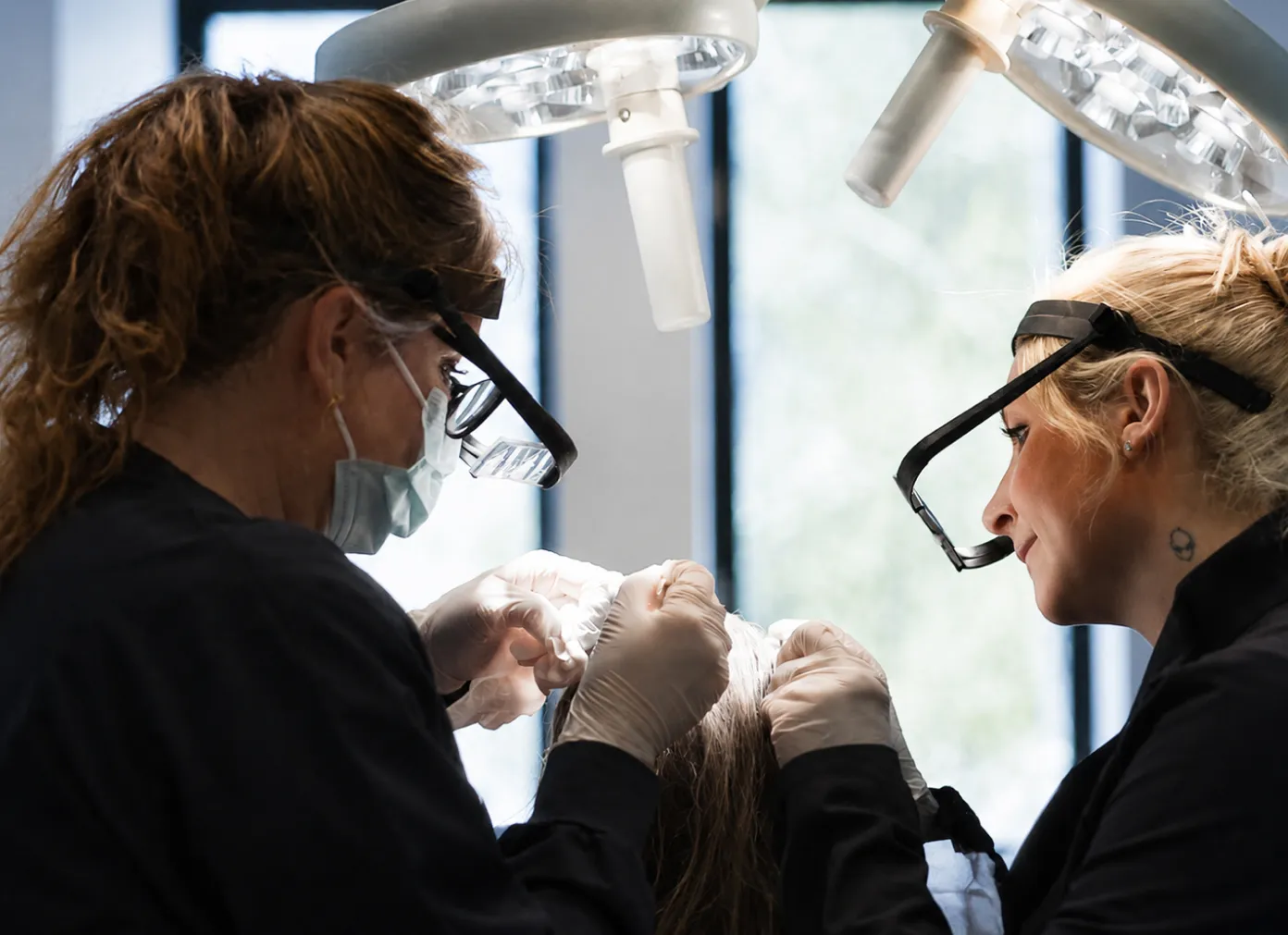
Hair Transplant (FUE)
A hair transplant moves follicular units from the donor area — the back and sides of the scalp, which are genetically less sensitive to androgens — into thinning or bald areas. Relocated hair keeps the characteristics of the area it came from.
We use the FUE technique: each follicular unit is extracted individually with a micropunch of [under 0.7 mm], leaving punctate micro-scars that are usually not noticeable when hair is worn short. Your result depends on the density and quality of your donor area, which we assess at consultation.
The number of follicular units, the hairline design and the distribution of density are planned before surgery, based on the stage of your hair loss and how it is likely to progress. Extraction, recipient site creation and implantation are performed by your physician.
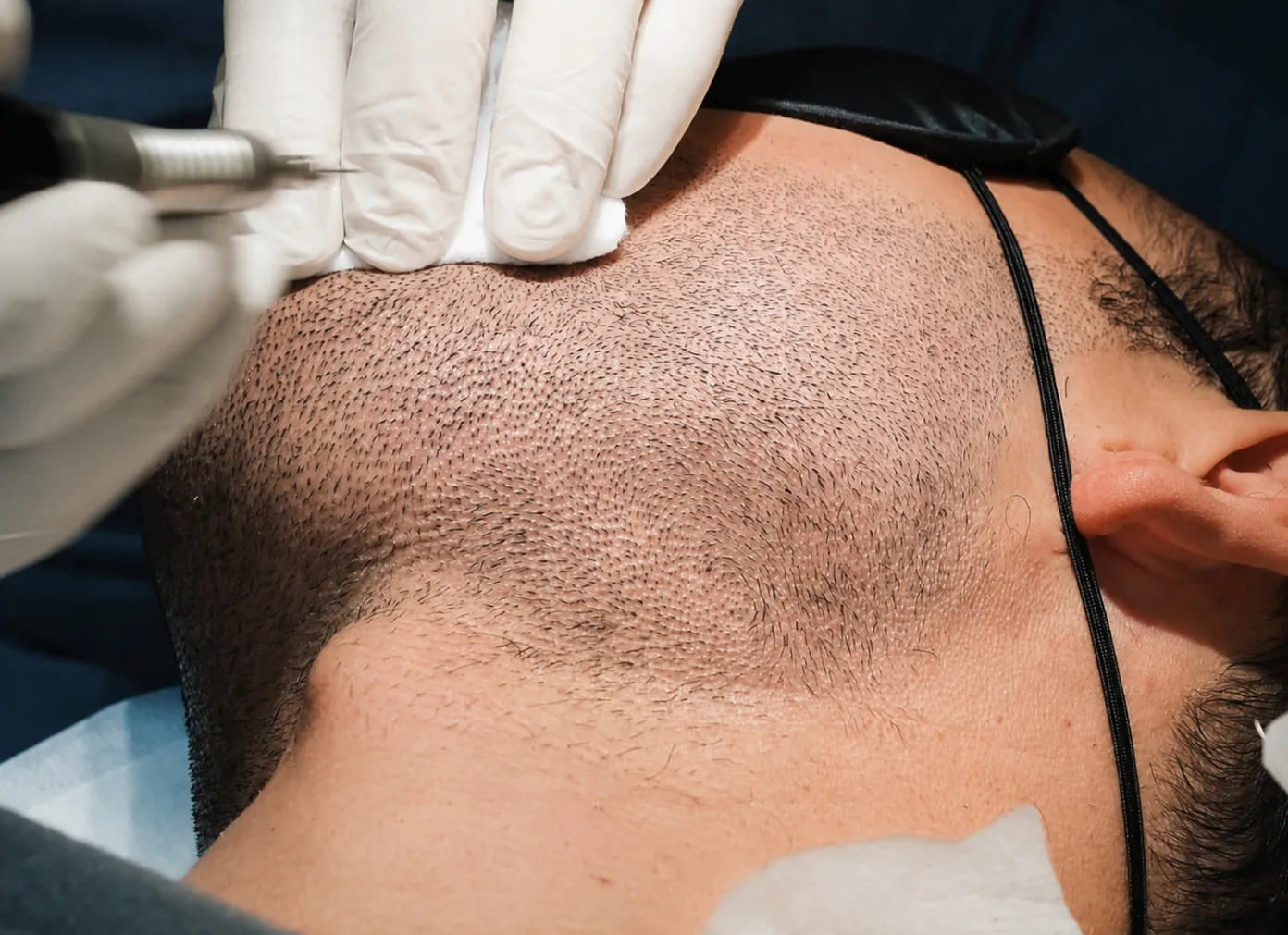
Beard Transplant
A beard transplant works on the same principle as a hair transplant: follicular units taken from the back of the scalp are implanted into sparse areas of the face — cheeks, jawline, moustache, chin or scars.
What makes the beard distinct is the angle. Facial hair grows almost flat against the skin, and implantation that ignores this produces a stiff, planted look. Each recipient site is therefore created to match the angle and direction of the native hair in that region of the face.
The procedure is also used to camouflage a scar, correct an asymmetry, or add density to genetically sparse facial hair.
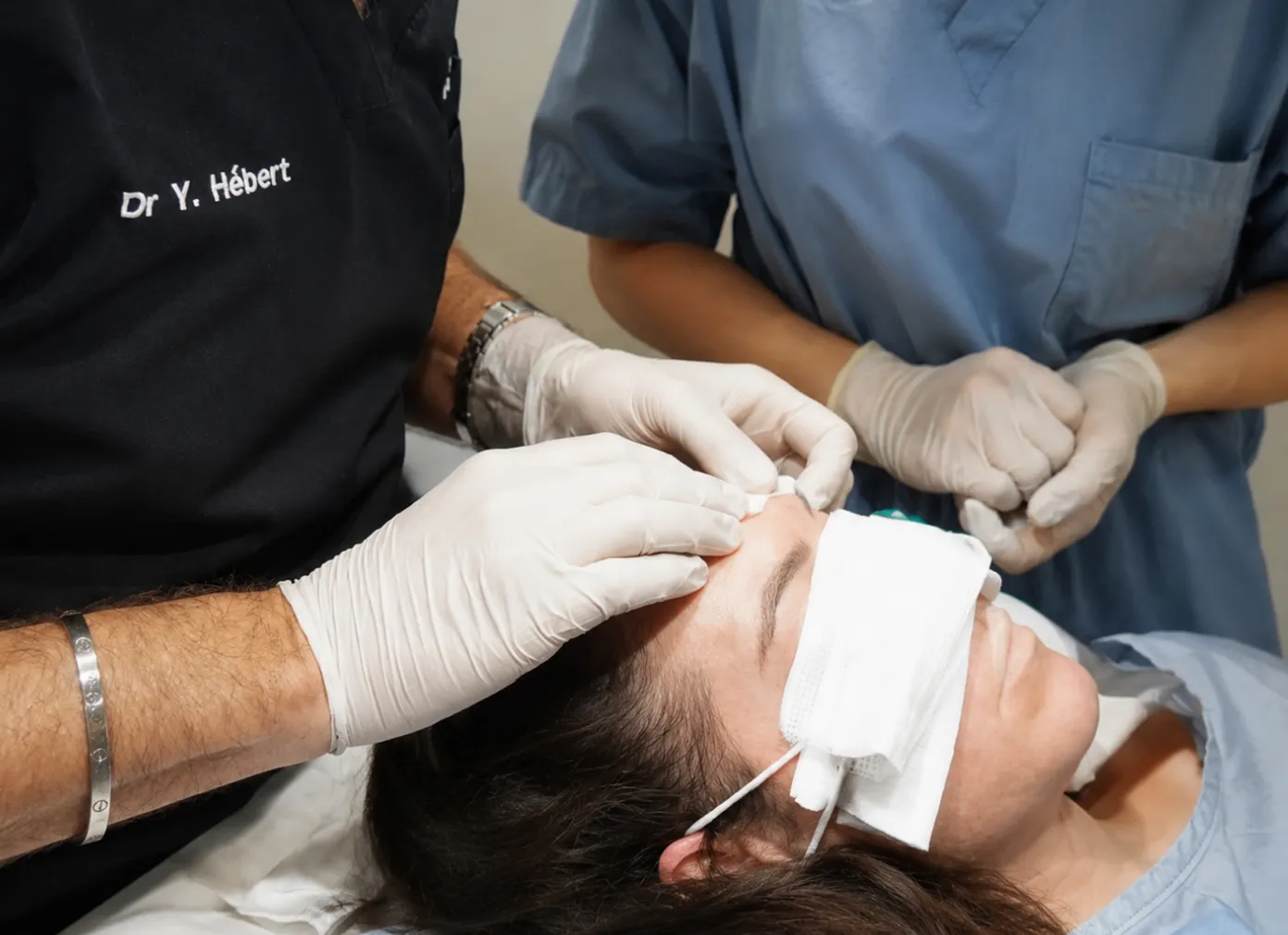
Eyebrow Transplant
An eyebrow transplant restores a sparse brow following repeated plucking, a scar, a burn, a medical treatment or a genetic predisposition.
It is the most demanding procedure in terms of design: eyebrows involve a small number of grafts, oriented differently along their length, and any error in angle is visible. The design is agreed with you before surgery, taking into account facial symmetry — which is never identical from one side to the other.
Transplanted brow hairs keep the growth rate of scalp hair and need to be trimmed regularly.
Medical and Regenerative Treatments
Not every patient is a surgical candidate, and in androgenetic alopecia surgery alone is never sufficient long term, because the condition is progressive. We therefore offer non-surgical treatments, either on their own or alongside a transplant:
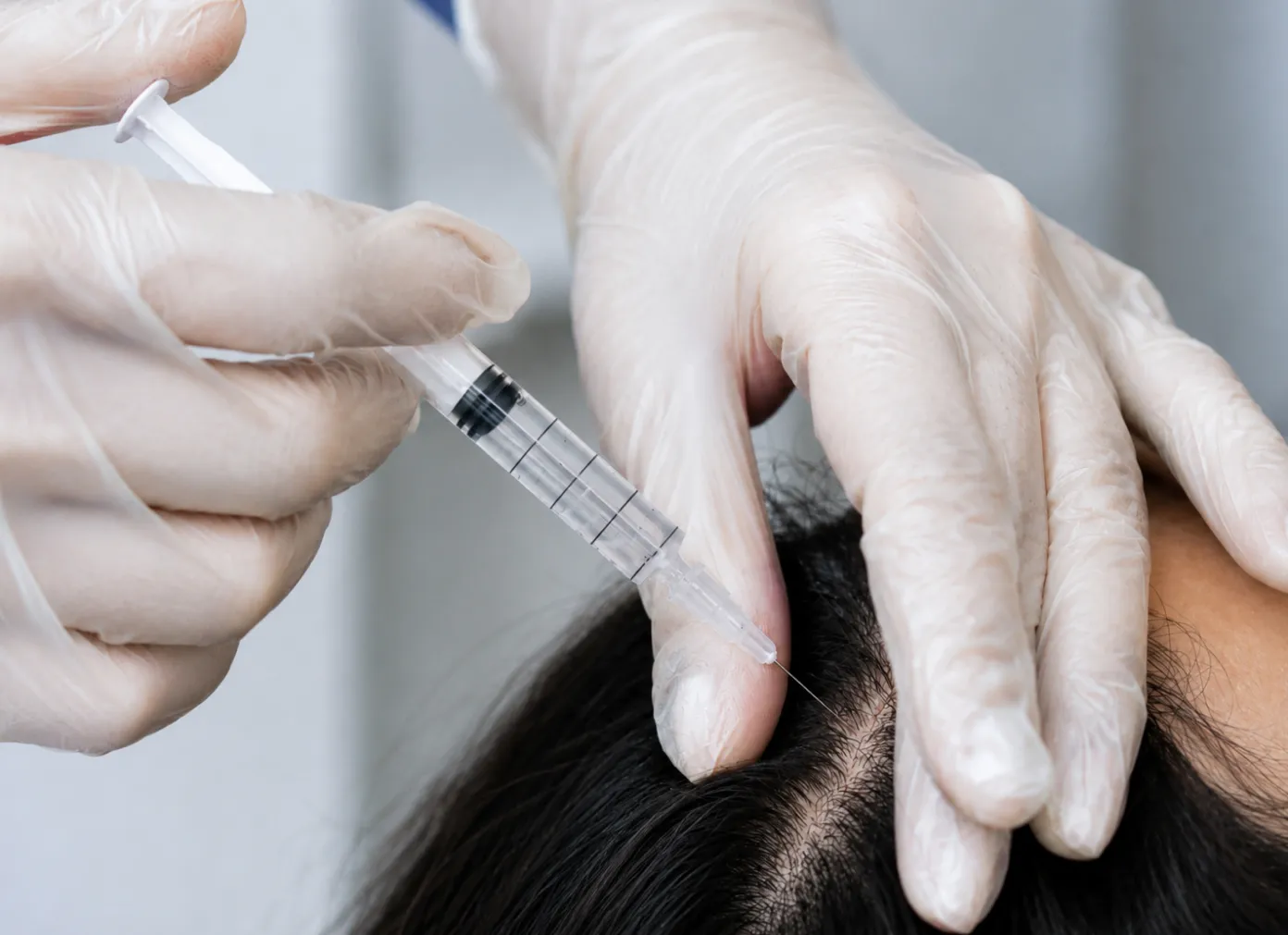
PRP (platelet-rich plasma): a blood sample is centrifuged to concentrate your own platelets, which are then injected into the scalp. The growth factors released by the platelets aim to support the follicles that are still present. The evidence is encouraging but varies between patients; PRP is most useful in early-stage hair loss and requires maintenance sessions.
Laser or LED biostimulation (LLLT): low-level light therapy, in clinic or at home.
[Microneedling]: mechanical stimulation of the scalp, sometimes combined with PRP. [term to be confirmed]
Medical therapy: depending on your profile — finasteride, topical minoxidil or other options discussed at consultation.
A PRP or biostimulation session takes 45 to 60 minutes including preparation. Where there is an effect, it becomes apparent after several months of treatment.
What Determines Your Treatment Plan
Whether we recommend surgery, medical treatment or both depends on four things we assess at consultation:
- The diagnosis. Androgenetic alopecia, scarring alopecia, telogen effluvium and traction alopecia are not treated the same way, and some are not operated on at all.
- The stage and rate of progression. Operating on rapidly progressing hair loss without medical stabilization leads to thinning around the transplanted area.
- The donor area. Its density determines how many follicular units are available — now and for any future procedure.
- Your expectations. They have to match the hair actually available. When they do not, we say so.
We sometimes recommend postponing surgery, or not operating at all. That is a normal part of our practice.
Risks and Normal Recovery
Every procedure carries risks, which are explained to you before surgery as part of informed consent.
Expected recovery: redness, forehead swelling for a few days, crusting at recipient sites, temporary tenderness or numbness in the donor area, and shedding of the transplanted hairs in the weeks after surgery (post-operative effluvium), followed by regrowth.
Less common risks: folliculitis, infection, delayed or insufficient regrowth, density below expectations, widened scar, and shock loss affecting native hair in the treated area.
FAQ
Find clear answers to frequently asked questions about our hair services, our approach, and the steps involved in a consultation at DHD.
What are the options for treating hair loss?
It depends on the cause. Options include hair transplantation, medical therapy (finasteride, topical minoxidil), regenerative treatments such as PRP and light biostimulation, and beard or eyebrow transplantation. The consultation exists first to establish a diagnosis; treatment follows from it.
What happens at a consultation?
Are transplant results permanent?
When will I see results?
No. PRP is mainly for early stages, when there are still follicles to support. In advanced hair loss it does not replace surgery. Results vary between individuals.
45 to 60 minutes, including preparation.
What aftercare follows a transplant?
You receive a written protocol covering washing, sleeping position, return to exercise, sun exposure and medication. Follow-up appointments are scheduled at the key stages of regrowth.
Who is a candidate?
Men and women whose hair loss is stable or can be stabilized and whose donor area is sufficient. A transplant is not indicated in untreated progressive hair loss in a young patient, active inflammatory alopecia, an insufficient donor area, or where expectations exceed the available hair. The medical assessment determines this.
Who performs the procedure?
A physician. Extraction of follicular units, creation of recipient sites and implantation are not delegated to technical staff. The nursing team assists the physician and prepares grafts under stereomicroscope.